RCM Automation 7 min read
AI Revenue Cycle Automation: From Eligibility to Payment
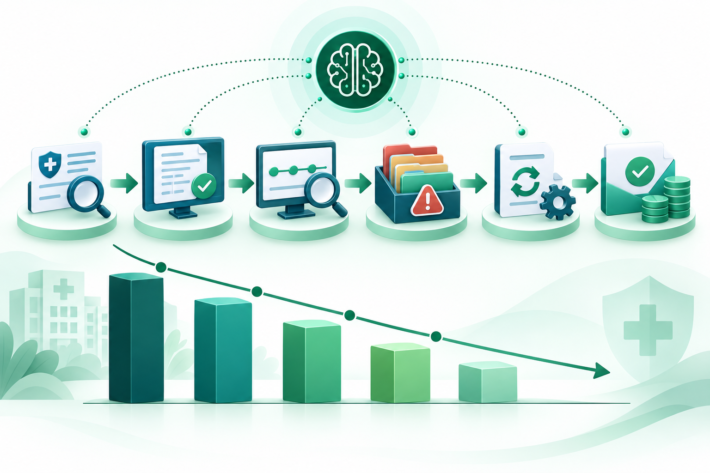
AI revenue cycle automation connects insurance eligibility checks, claim submission, payer-status monitoring and follow-up. Healthcare revenue cycle management starts before submission and continues through payment.
Traditionally, these activities are handled through separate manual processes. Staff may check payer portals, verify eligibility, update systems, monitor claims, and follow up on unresolved accounts.
AI-powered RCM automation can connect these workflows and reduce repetitive work across the revenue cycle.
The goal is simple: verify earlier, monitor continuously, act on exceptions, and improve the path to payment.Table of Contents
Toggle1. What Does the Revenue Cycle Look Like From Eligibility to Payment?
A simplified revenue cycle looks like:
Patient Registration → Eligibility Verification → Service → Claim Submission → Claim Status → Follow-Up → Payment
Each stage affects the next.
If insurance information is not verified correctly, a billing team may later encounter coverage-related problems. Similarly, submitting a claim does not mean the claim will automatically move to payment. It still needs to be monitored and followed up when necessary.
This is why healthcare organizations should look at the revenue cycle as a connected workflow rather than a collection of isolated tasks.
For the submission stage, use our claim submission process guide to review the steps between preparing a claim and monitoring its payer response.
2. Why Eligibility Verification Matters
Eligibility verification is one of the earliest opportunities to identify potential billing problems. AI eligibility verification can help automate repetitive coverage and benefits checks while allowing staff to focus on exceptions.
Before providing a service, teams may need to determine:
- Is the patient’s insurance active?
- What benefits are available?
- Is the service covered?
- What are the patient’s deductible and copay?
- Is coinsurance applicable?
- Is prior authorization required?
When these checks are performed manually, staff may have to move between payer portals, EHRs, practice-management systems, and other tools.
For a practical checklist, see the eligibility verification process in medical billing, including what teams should review before service.
From Checking Information to Taking Action
The challenge is not simply obtaining eligibility information.
The bigger challenge is understanding what needs attention.
An automated eligibility workflow can help organize verification results and surface exceptions so staff can focus on cases that require human judgment instead of spending time repeating the same checks.
3. The Problem With Manual Claim Follow-Up
After a claim is submitted, billing teams need to know what is happening with it.
Was it received? Is it still processing? Was it rejected or denied? Has payment been issued? Does it require follow-up?
When this process is manual, employees may repeatedly:
Open claim → Check payer → Review response → Document status → Determine next step → Set reminder → Repeat
For hundreds or thousands of claims, this can consume significant staff time.
Turning Claim Status Into Action
Claim status automation can help monitor submitted claims, organize payer responses, and identify claims that require attention.
Instead of asking employees to manually check every claim, automation can help surface exceptions and direct them to the appropriate work queue.
The goal is not to remove humans from RCM.
The goal is to remove unnecessary repetitive work so RCM professionals can focus on exceptions and decisions.
Our AI claim-status and AR follow-up workflow shows how status responses can be organized into a human-reviewed work queue.
4. How AI Connects Eligibility and Claim Status
Eligibility verification and claim-status follow-up happen at different stages, but they are connected.
The front-end workflow may look like:
Front-End Workflow
Patient Scheduled → Eligibility Checked → Coverage Confirmed → Exceptions Identified
The back-end workflow may look like:
Back-End Workflow
Claim Submitted → Claim Monitored → Status Identified → Follow-Up → Payment
Without automation, these workflows may involve different employees and systems.
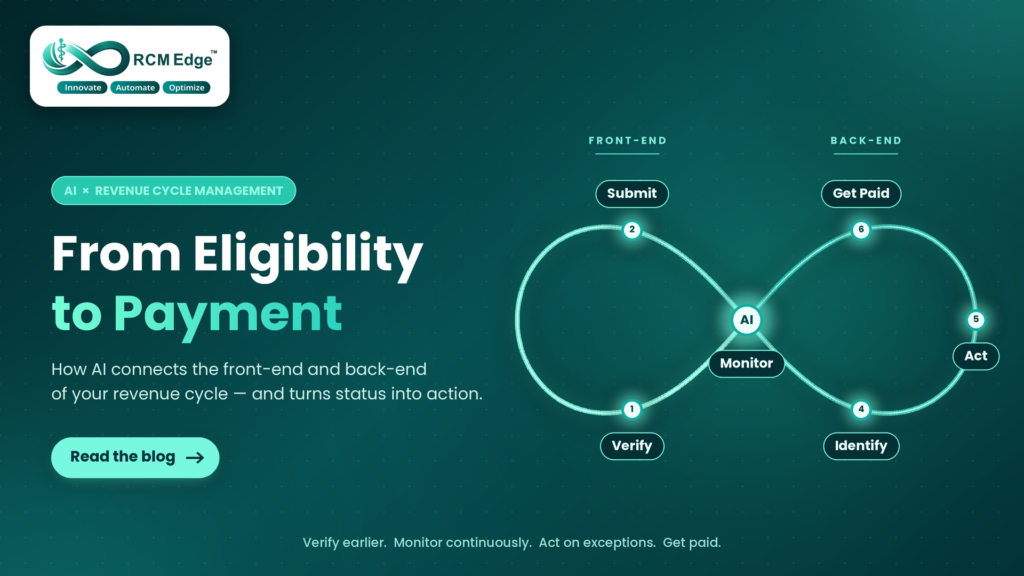
With connected automation, organizations can create a more continuous process:
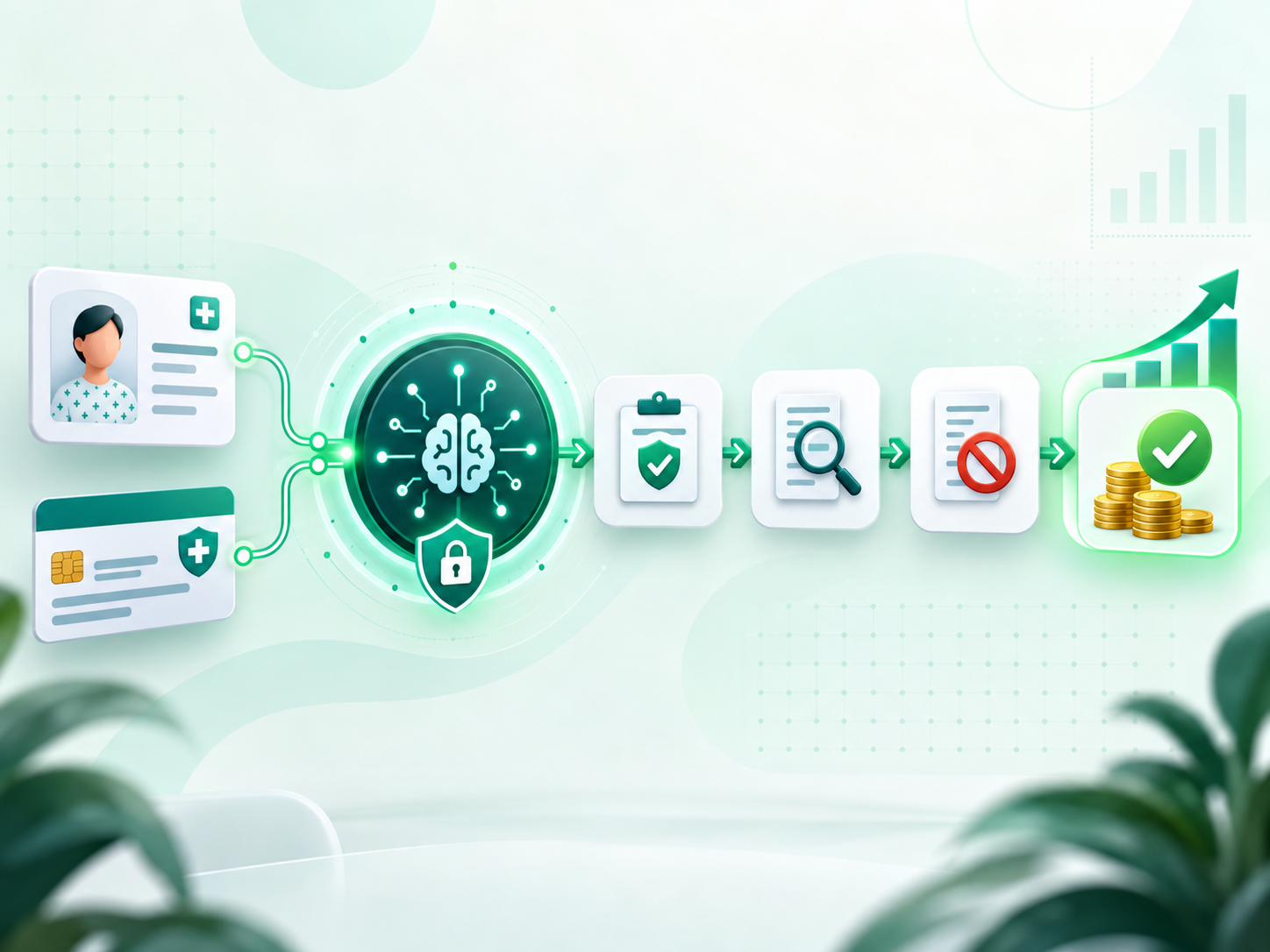
Verify → Submit → Monitor → Identify → Act → Get Paid
For example, eligibility automation can help identify coverage issues before service. Later, claim-status automation can monitor the submitted claim and identify when follow-up is required.
This creates a more connected approach to revenue cycle management.
Review the RCM Edge platform to understand how eligibility checks, claim-status information and exception handling fit into a connected workflow.
5. Where AI Can Help in RCM
AI and automation can support several repetitive revenue-cycle activities.
Eligibility Verification
Automated eligibility workflows can help reduce repetitive coverage and benefits checks and surface information that requires attention.
Claim Status Monitoring
Automation can monitor supported claim-status workflows and help billing teams identify claims that need follow-up.
Exception Routing
Not every claim requires the same action. Automation can help separate routine cases from exceptions so experienced staff can focus on more complex accounts.
Follow-Up Prioritization
Large claim queues can be difficult to manage manually. Automation can help organize work based on claim status, aging, payer responses, and other operational factors.
For unresolved balances, use the step-by-step guide to reducing days in AR. When comparing tools, the healthcare AR automation buyer’s guide provides evaluation criteria for integrations, exceptions and pilot evidence.
6. How to Start Automating Your RCM Workflow
Organizations do not need to automate everything at once.
A practical approach is to start with one repetitive, high-volume workflow.
Step 1: Identify the Biggest Bottleneck
Determine where your team spends the most time.
For example:
- Eligibility verification
- Claim-status checks
- Payer portal work
- Follow-up
- AR worklists
Step 2: Measure the Current Process
Before automation, understand your current workload.
Look at transaction volume, staff time, manual touches, processing time, and unresolved accounts.
Use the eligibility verification automation ROI calculator as a transparent planning exercise, then validate its inputs against your own operating data before making an investment decision.
Step 3: Start Small and Expand
Choose a defined workflow or claim population, measure the results, and expand automation once the process is working consistently.
Most importantly, keep exceptions visible. Automation should make problems easier to identify not hide them.
7. Key Benefits of Connected RCM Automation
Connecting front-end and back-end workflows can help organizations achieve several operational benefits:
Less Repetitive Manual Work
Teams spend less time repeatedly checking payer information and claim status.
Earlier Identification of Problems
Eligibility issues can be identified before they become downstream billing problems.
Better Claim Visibility
Automated monitoring can help keep submitted claims visible throughout the payer process.
More Focused Staff Time
Employees can spend more time on exceptions, payer issues, and complex accounts.
Better Scalability
Growing billing companies can handle increasing transaction volumes without relying entirely on proportional increases in manual work.
8. Frequently Asked Questions
What is AI-powered revenue cycle automation?
AI-powered RCM automation uses technology and intelligent workflows to support repetitive activities such as eligibility verification, claim-status monitoring, exception handling, and follow-up.
What is AI eligibility verification?
AI eligibility verification automates parts of the process of checking patient insurance coverage and benefits, helping teams identify information or exceptions that require attention.
What is AI claim status automation?
AI claim status automation helps monitor submitted claims, retrieve available payer-status information, organize responses, and identify claims that may require follow-up.
Can eligibility verification prevent claim denials?
It can help identify certain coverage-related issues before a claim is submitted. However, it cannot prevent every denial because denials can have many different causes.
Does RCM automation replace billing employees?
No. The strongest use of automation is to handle repetitive work while allowing RCM professionals to focus on exceptions, complex cases, and decisions requiring human judgment.
Why connect eligibility and claim status automation?
Connecting the two creates a more continuous revenue-cycle workflow:
Eligibility → Claim → Status → Follow-Up → Payment
This can reduce repetitive work and give RCM teams better visibility into the overall claim lifecycle.
9. Conclusion: Move From Manual Tasks to Connected RCM Workflows
Revenue cycle automation is not simply about automating individual tasks.
The bigger opportunity is connecting the workflows that already exist.
Eligibility verification can help identify coverage issues before service. Claim-status automation can help keep submitted claims visible and surface accounts that require action.
Together, these workflows can help healthcare organizations reduce repetitive manual work while allowing RCM professionals to focus on the areas where human judgment matters most.
Verify earlier. Monitor continuously. Act on exceptions. Move toward payment with greater visibility.
See Where Your RCM Workflow Can Be Automated
RCM Edge helps healthcare organizations and medical billing teams automate eligibility verification and claim-status workflows.
If your team is spending hours checking eligibility or manually following up on claims, explore which parts of your RCM workflow can be automated.
Get Free Assessment to identify self-reported automation opportunities and request a downloadable report before planning your next step.