RCM Automation 1 min read
Eligibility Verification Automation ROI Calculator (2026)
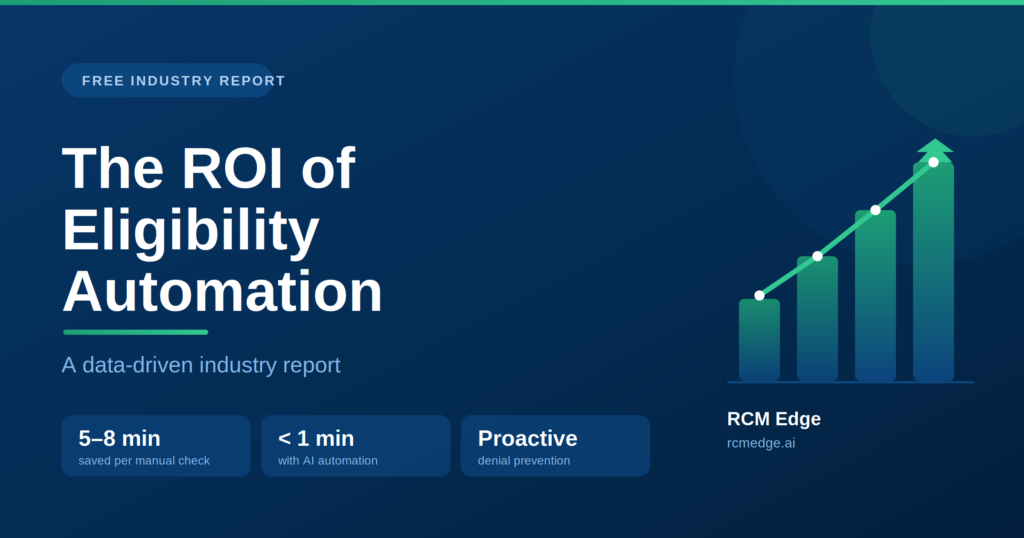
Estimate the staff hours, labor-capacity value, net benefit, ROI, and payback period of eligibility verification automation using your own volumes and costs.
Transparent methodology: the calculator starts with time benchmarks from the 2024 CAQH Index, which reports 2023 operating data. Replace every default with your organization's observed data before using the result in a business case. Calculations run only in your browser; no entries are transmitted or stored.
Table of Contents
ToggleEligibility automation benchmark
The CAQH report estimates a $11.5 billion provider cost-savings opportunity for medical eligibility and benefit verification, with an $11.744 billion opportunity across providers and plans. The report's cost model covers labor time and explicitly excludes software and equipment costs, so this calculator asks you to enter those costs separately.
Eligibility verification automation ROI calculator
Estimated annual business case
Labor-capacity model based on your inputs.
Formulas
Annual hours released = monthly checks × (current minutes − future staff-touch minutes) ÷ 60 × 12
Labor-capacity value = annual hours released × loaded hourly cost
Net benefit = labor-capacity value − annual automation cost
ROI = net benefit ÷ annual automation cost × 100
Example sensitivity table
These examples use a 12-minute time opportunity and a $30 loaded hourly cost. They are arithmetic illustrations, not RCM Edge performance claims.
| Checks/month | Hours released/year | Annual labor-capacity value | Automation cost |
|---|---|---|---|
| 500 | 1,200 | $36,000 | Enter vendor quote |
| 2,000 | 4,800 | $144,000 | Enter vendor quote |
| 5,000 | 12,000 | $360,000 | Enter vendor quote |
What to include in the real business case
- Observed eligibility volume by payer, location, and workflow.
- Staff time for portal work, calls, documentation, and rechecking.
- Exception rate and the time required for human resolution.
- Loaded labor cost rather than base wage alone.
- Implementation, integration, support, and recurring platform costs.
- A controlled baseline and post-launch measurement period.
What this calculator does not claim
No guaranteed denial reduction
An eligibility response supports coverage checking but does not guarantee claim payment. Model denial effects separately with your own root-cause data.
No assumed software price
RCM Edge pricing is not included. Enter a management-approved vendor quote and all implementation costs.
No replacement of financial review
This is a planning model, not accounting, legal, reimbursement, or investment advice.
Implementation measurement plan
- Baseline: measure checks, staff minutes, exception rate, and completion time for at least two representative weeks.
- Pilot: start with defined payers or locations and preserve a comparable control period.
- Measure: track electronic completion, exception handling, rechecks, and staff-touch minutes.
- Recalculate: replace all benchmark inputs with observed post-launch data.
- Expand: scale only after the operational and financial result is verified.
Primary sources
2024 CAQH Index
Provider transaction time, methodology, adoption, and medical eligibility cost-savings opportunity. The report uses 2023 operating data.
Read the CAQH reportCMS eligibility transaction
CMS explains the HIPAA-adopted X12 270 eligibility inquiry and 271 response and the required real-time operating rules.
Read the CMS overviewCMS operating-rules FAQ
CMS notes that an eligibility response does not guarantee reimbursement, an important limit for ROI modeling.
Read the CMS FAQRelated RCM Edge resources
See the insurance eligibility verification software workflow, the step-by-step eligibility verification process, the broader RCM automation workflow, and our RCM software buyer comparison.
Frequently asked questions
How do you calculate eligibility verification automation ROI?
Estimate annual staff hours released, multiply by loaded labor cost, subtract annual automation costs, and divide the net benefit by annual automation costs. Replace benchmarks with observed workflow data.
What time benchmark should an organization use?
The 2024 CAQH Index reports averages of 16 minutes for a manual medical eligibility transaction and 4 minutes for a fully electronic transaction. Your own time study is stronger evidence.
Should denial savings be included?
Only when your organization has reliable denial root-cause, rework-cost, and preventability data. Eligibility responses do not guarantee reimbursement, so this calculator focuses on labor capacity.
Does the calculator store patient or financial data?
No. The calculator asks only for operational assumptions, runs in the visitor's browser, and does not transmit or store entries.
What costs should be entered?
Include implementation, interfaces, recurring platform fees, support, internal project time, and any other approved costs required to operate the workflow.
Validate the model on your workflow
Bring your eligibility volume, payer mix, and exception process to a 30-minute RCM Edge demo.
Last reviewed August 26, 2026. Benchmarks are attributed to the 2024 CAQH Index and should not be interpreted as guaranteed RCM Edge results.

Mithali Parekh
Mithali Parekh is a healthcare technology professional specializing in revenue cycle management (RCM) automation and medical billing workflow optimization. She focuses on helping healthcare providers and billing companies improve operational efficiency by leveraging automation for processes such as claim status tracking, eligibility verification, and denial prevention.