IN DEVELOPMENT · PRIOR AUTHORIZATION

Prior Authorization Automation Software That Keeps Requests Moving

Edge PA is in development. This page outlines the planned prior authorization workflow from intake through payer follow-up, including status visibility and staff-routed clinical or payer exceptions.

Structured authorization workflows | Payer follow-up | HIPAA | SOC 2 Type II

THE OPERATIONAL PROBLEM

Manual Prior Authorization Creates Delays Across Clinical and Revenue Teams

Requests often move between scheduling, clinical documentation, payer portals, phone calls, and spreadsheets. Missing information or unclear ownership can leave authorizations waiting without visibility.

Manual Authorization Work

Staff gather documents, check payer requirements, submit requests, and follow status one case at a time. Updates are fragmented and urgent exceptions compete with routine follow-up.

Planned Prior Authorization Workflow

The planned Edge PA workflow is designed to standardize intake and repeatable payer steps, record status, and send incomplete or clinical exceptions to an accountable review queue.

CORE CAPABILITIES

Planned Automation Around Every Authorization

Create a consistent workflow while keeping clinicians and authorization specialists responsible for medical judgment and payer-specific exceptions.

Authorization Intake

Organize patient, order, service, payer, and provider information for the request.

Requirement Checks

Apply defined payer and workflow rules before submission.

Submission Workflows

Complete repeatable portal and payer submission steps with a consistent record.

Status Monitoring

Track pending requests without relying on repeated manual checks.

Exception Routing

Send missing documentation, clinical questions, and payer issues to the correct owner.

Confirm coverage before authorization work progresses.

HOW IT WORKS

Planned Workflow: From Order Intake to Authorization Decision

The planned workflow is designed to work around existing EHR, scheduling, clinical, and payer processes. Compatibility and access requirements must be validated before deployment.

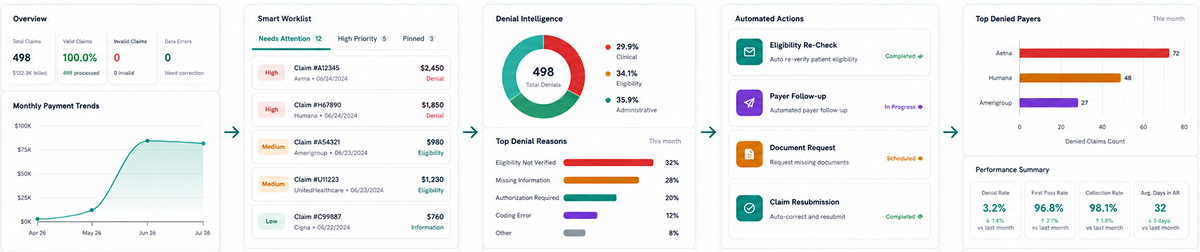
How RCM Edge automation works, step by step

01. Collect Request Data

Bring together the patient, service, payer, provider, and available clinical information.

02. Validate Requirements

Check defined workflow rules and identify missing documentation before submission.

03. Submit and Monitor

Execute repeatable payer steps and continue checking pending requests.

04. Route the Decision

Send approvals, requests for information, and other exceptions to the correct team.

OPERATIONAL OUTCOMES

Create a More Predictable Authorization Workflow

Automation reduces routine coordination while giving staff clearer ownership of cases that require clinical input, payer escalation, or patient communication.

Less Status Chasing

Reduce repeated portal checks and payer calls.

Earlier Missing-Data Flags

Surface incomplete requests before they remain idle.

Clearer Ownership

Route each exception to the right clinical or authorization team.

Consistent Tracking

Maintain one structured record from intake through decision.

BUILT FOR YOUR TEAM

Prior Authorization Automation for Every RCM Operating Model

Standardize repeatable workflows across clients, specialties, and payer mixes.

Reduce administrative burden and give staff clearer exception-based work queues.

Create consistent processes, visibility, and governance across a larger operation.

FREQUENTLY ASKED QUESTIONS

Prior Authorization Automation Frequently Asked Questions

What is prior authorization automation?

Prior authorization automation uses rules, integrations, and RPA to complete repeatable intake, submission, status, and routing tasks while staff handle clinical and payer exceptions.

Does automation replace clinical review?

No. Clinical judgment, medical-necessity review, and payer escalations remain with qualified staff. Automation supports the repetitive coordination around those decisions.

Can Edge PA work with our current systems?

RCM Edge is designed to work around existing EHR, scheduling, practice-management, clearinghouse, and payer workflows.

Can we begin with one payer or service line?

Yes. A focused rollout can validate rules and exception handling before expansion to more payers, locations, or services.

SEE THE WORKFLOW ON YOUR DATA

Discuss the Edge PA Roadmap

Bring your payer mix, request volume, current handoffs, and most common delay reasons. We will map the repeatable work and show where staff oversight remains essential.

Let’s talk RCM

Ready to automate your revenue cycle?

Tell us where your team spends the most time. We’ll show you how RCM Edge can streamline the workflow, reduce manual follow-up, and accelerate reimbursement.

Healthcare revenue cycle workflow moving through secure AI automation to approved payment
566 eligibility payer connections 468 claim-status payer connections Secure automation

Talk with an RCM specialist

Share a few details and our team will contact you with the right next step.

Latest Blogs

News and stories center

Explore insightful content that keeps you ahead of the curve to the pulse of what’s happening.

RCM EDGE · RPA & AUTOMATION

Discover What’s Possible with RCM Automation

Facing claim denials, payment delays, or inefficient manual processes?

Our team can assess your current RCM workflow and identify opportunities to improve efficiency, accelerate collections, and reduce operational effort with AI and automation.

Schedule your free assessment call to get started.

sales@rcmedge.ai
Coming Soon