
Denial Management 6 min read
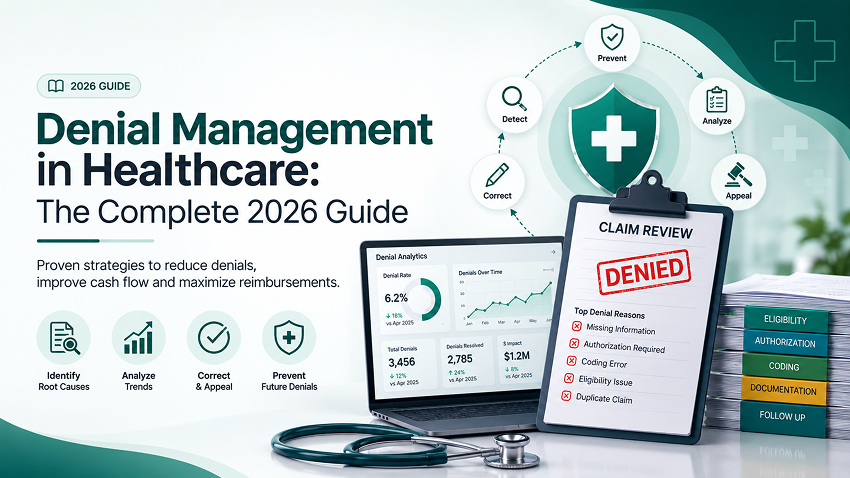
Denial Management in Healthcare: The Complete 2026 Guide
Key takeaways
- Roughly two-thirds of denied claims are never reworked, even though many would have been paid on a corrected resubmission.
- Most denials are administrative and preventable — eligibility, prior auth, registration and coding errors.
- Preventing a denial is almost always cheaper than appealing one (rework costs an estimated $25–$118 per claim).
- Track denial rate, overturn rate, clean claim rate, days to rework and write-off rate — by payer and reason code.
- Automation typically cuts denial rates by about a third while holding headcount flat.
Claim denials are the single largest pool of recoverable revenue most healthcare organizations leave on the table. Industry benchmarks put initial denial rates between 5% and 15%, and studies repeatedly find that roughly two-thirds of denied claims are never reworked — written off as lost even though the payer would have paid on a corrected, well-documented resubmission. That is earned revenue lost to process gaps, not to clinical or contractual reality.
Denial management in healthcare is the discipline of preventing, tracking and recovering those denied claims — and, just as importantly, feeding what you learn back upstream so the same denials stop happening. This guide covers what denial management is, why claims are denied, the seven-step process, the KPIs that matter, and how automation turns denial work from reactive firefighting into prevention. If you want the fast definition first, see our short explainer on what denial management is; for the step-by-step workflow, see the 7-step denial management process.
What denial management is — and why it pays off
Denial management is the structured process of identifying why insurance claims are denied, correcting and appealing them to recover revenue, and fixing the root causes so recurrence drops over time. It spans the entire revenue cycle: patient access and eligibility at the front end, coding and claim submission in the middle, and payer adjudication and appeals at the back. Strong denial management does not just rework denials faster — it steadily reduces how many happen at all, which is where the durable ROI lives. A denied claim costs, by common estimates, $25–$118 to rework; preventing it is almost always cheaper than appealing it.
Why healthcare claims get denied
Most denials are administrative and preventable. The recurring causes:
- Eligibility and coverage issues — patient not covered, plan inactive, or benefits never verified
- Missing or invalid prior authorization
- Registration and demographic errors — wrong member ID, name mismatch, incorrect date of birth
- Coding errors — incorrect, unbundled or non-covered codes, and medical-necessity mismatches
- Missing documentation to support the claim
- Timely filing — the claim was submitted after the payer’s deadline
- Duplicate claims or coordination-of-benefits problems
Because so many of these originate at the front desk, denial management is really a whole-cycle responsibility. Verifying coverage before the visit and submitting a clean claim the first time — measured by your clean claim rate — prevents the majority of downstream denials.
The denial management process, in brief
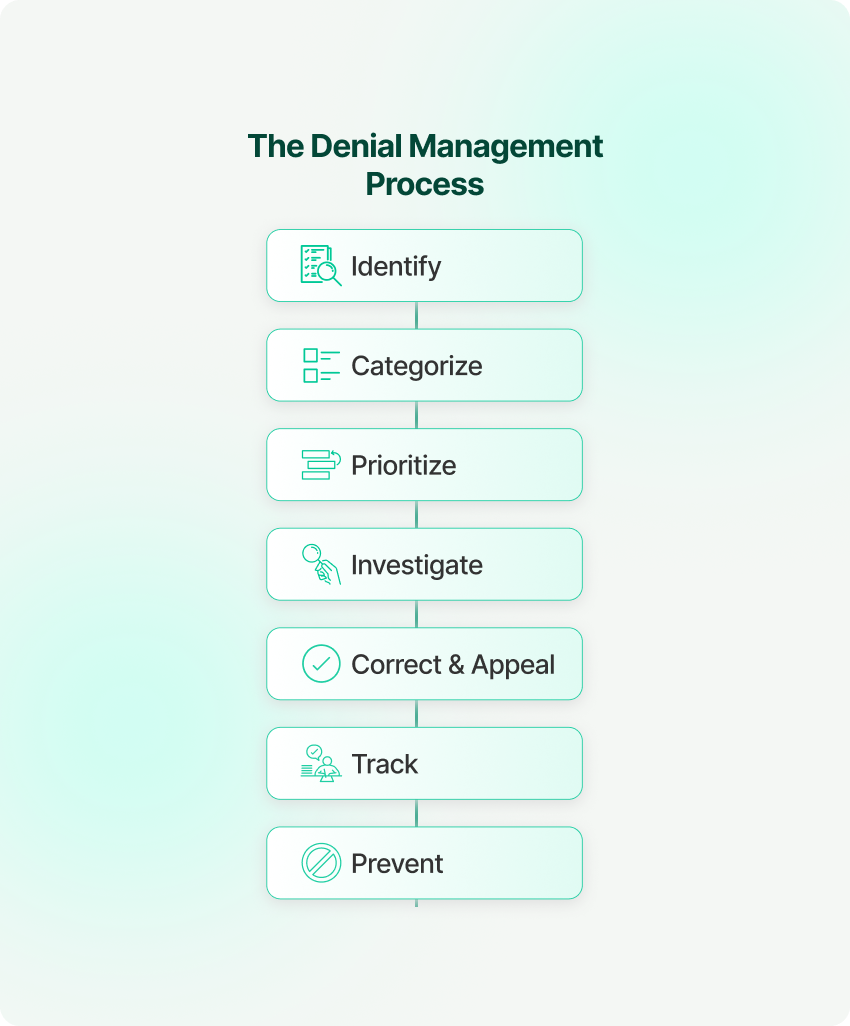
The full workflow is covered in our 7-step denial management process guide, but in short: identify every denial from remittances and portals, categorize by reason code and payer, prioritize by recoverable value, investigate the true root cause, correct and appeal on time, track overturn rates, and prevent recurrence by feeding root causes back upstream.
Denial management KPIs to track
- Initial (first-pass) denial rate — % of claims denied on first submission; target single digits
- Denial overturn / recovery rate — % of appealed denials that get paid
- Clean claim rate — % accepted with no edits; target 95%+
- Days to rework — time from denial to corrected resubmission
- Denial write-off rate — denied dollars never recovered
Track each of these by payer and by reason code. That cross-tab is where the actionable patterns hide: one payer driving eligibility denials, one provider driving coding denials, one CPT driving medical-necessity denials.
Preventing denials: moving from reactive to proactive
The cheapest denial is the one that never happens. Prevention means verifying eligibility in real time before the visit, confirming prior authorizations up front, scrubbing claims for coding and documentation errors before submission, and watching timely-filing windows. When front-end and back-end teams share denial data, the same mistakes stop repeating.
How automation strengthens denial management
Manual denial management doesn’t scale: as volume grows, denials pile up and get worked late or written off. Automation changes the economics. Eligibility and prior-authorization checks run automatically before the claim goes out; claim scrubbing catches errors pre-submission; and denials are captured, categorized and routed the moment they post. Predictive denial detection goes further, scoring each claim for denial risk before it is filed so high-risk claims are fixed first. Teams typically cut denial rates by around a third while holding headcount flat. See how RCM Edge does this end to end on our denial management software page.
Frequently asked questions
The process of identifying why claims are denied, correcting and appealing them to recover revenue, and fixing root causes so the same denials stop recurring — across the full revenue cycle.
A rejection happens before adjudication (a data/format error, often caught by the clearinghouse) and can be corrected and resubmitted. A denial is a processed claim the payer declines to pay, and usually requires an appeal.
A first-pass denial rate in the low single digits is strong; many organizations sit at 5–15%. Pair it with a clean claim rate of 95%+ and a high recovery rate.
Eligibility/coverage, missing prior authorization, registration errors, coding and medical-necessity mismatches, missing documentation, and timely-filing problems.
It varies by payer and plan — often 30 to 180 days from the remittance date. Tracking appeal deadlines is a core part of the process.
By verifying eligibility and prior auth up front, scrubbing claims before submission, capturing and routing denials instantly, and scoring claims for denial risk before filing.
Use RCM Edge revenue cycle analytics to monitor denial trends by payer, reason, and workflow alongside the rest of your revenue cycle performance.
Related reading
- The Denial Management Process: 7 Steps to Recover Revenue
- What Is Denial Management? Definition, Codes & KPIs
- Clean Claim Rate: Benchmarks and How to Improve It
Ready to prevent denials before they happen? See RCM Edge denial management software or Book a 30-Minute Demo.
