
Denials 5 min read
The Denial Management Process: 7 Steps to Recover Revenue
Key takeaways
- A repeatable process gives every denial a defined owner, next action and measurable outcome.
- Work denials by dollar value and recoverability, not arrival order.
- Fix the root cause, not just the reason code.
- Use automation only where the available workflow and payer requirements support it; keep judgment and appeal responsibility explicit.
A repeatable denial management process helps teams identify actionable denials, choose the appropriate correction or appeal path, and learn from recurring causes. Recovery depends on payer requirements, documentation and claim circumstances; it is not guaranteed. Here are seven operational steps.
What is the denial management process?
The denial management process is a structured workflow for identifying denials, determining whether correction, reconsideration or appeal is appropriate, tracking outcomes, and reducing recurrence. For broader context, see the denial management definition and KPI guide.
The 7 steps
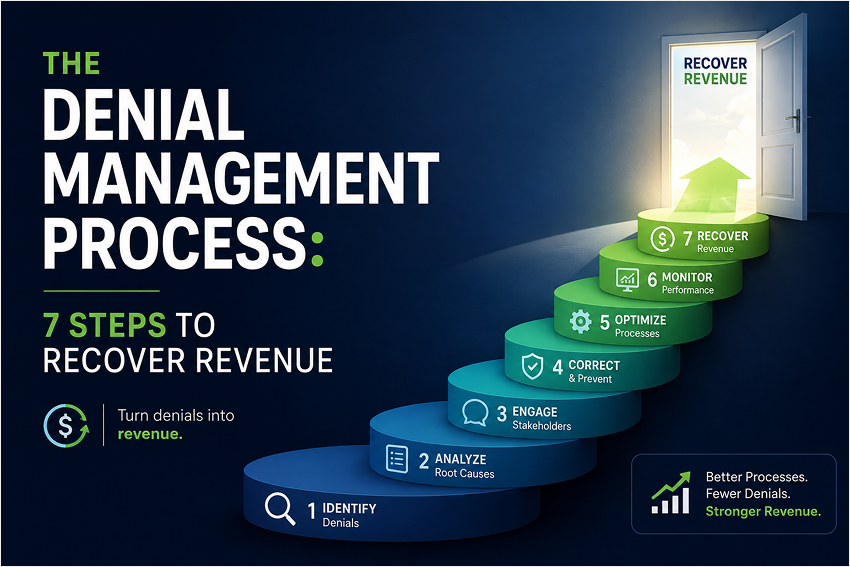
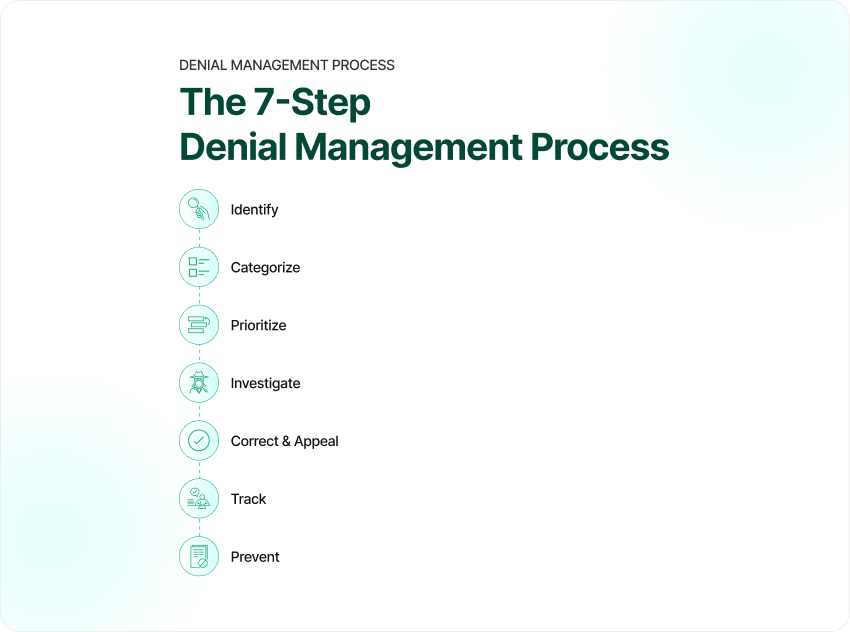
- Identify — capture every denial from remittances (835s) and payer portals.
- Categorize — group by reason code, payer, provider and dollar value.
- Prioritize — work the highest-value, most-recoverable denials first.
- Investigate — find the true root cause behind the reason code.
- Correct & appeal — fix the claim and submit a documented appeal on time.
- Track — monitor appeal status and overturn rates.
- Prevent — feed root causes back to front-end teams so it doesn’t recur.
What each denial management step should produce
A denial queue becomes actionable when each step produces a documented output—not just another status. For remittance-based denials, use the group code, Claim Adjustment Reason Code (CARC), Remittance Advice Remark Code (RARC), claim data, payer instructions, and the underlying documentation together. CMS explains how these standard remittance codes describe claim- and line-level adjustments; the code alone does not determine whether the next action is a correction, reopening, reconsideration, or appeal.
| Step | Required operational output | Control to verify |
|---|---|---|
| 1. Identify | A denial record tied to the claim, line, payer, amount, remittance date, codes, and source document. | Every ERA, paper remit, and payer-portal denial enters one owned queue. |
| 2. Categorize | A consistent reason and root-cause category, not only the payer’s message. | Group code, CARC, RARC, payer rule, and responsible workflow are retained. |
| 3. Prioritize | A work score based on filing deadline, dollar value, recoverability, and effort. | Urgent deadlines and high-value recoverable claims rise above arrival order. |
| 4. Investigate | The missing, incorrect, or conflicting evidence that explains the denial. | Staff can distinguish registration, eligibility, authorization, coding, documentation, submission, and payer-processing causes. |
| 5. Correct or appeal | The correct action path, supporting documents, submission destination, and due date. | Payer-specific instructions are verified before work is submitted. |
| 6. Track | An owner, status, next follow-up date, payer response, decision, and recovered amount. | No denial sits without a next action or ages past a filing limit unnoticed. |
| 7. Prevent | A root-cause action assigned to the upstream team with a recurrence measure. | The same avoidable denial category declines over a defined measurement period. |
Metrics for a denial management workflow
- Initial denial rate: denied claims or dollars divided by the agreed submitted-claim denominator.
- Clean claim rate: claims accepted without preventable correction or rework. Keep the definition consistent; see the clean claim rate benchmark and improvement guide.
- Appeal turnaround time: days from denial receipt to a complete correction or appeal submission.
- Overturn rate: favorable decisions divided by decided appeals, separated by payer and denial category.
- Recovered amount: payment attributable to completed denial work, reported separately from submitted appeal value.
- Aged denial inventory: open denial dollars and counts by age band and filing deadline.
- Preventable recurrence: whether the targeted root-cause category falls after a workflow change.
Use one written definition and data source for each metric. Pair denial results with upstream controls such as the eligibility verification process and downstream claim status follow-up so the team can see whether an intervention prevents rework or only moves it to another queue.
Common mistakes that slow denial recovery
- Working denials in the order they arrive instead of by value
- Missing appeal deadlines
- Fixing the symptom, not the root cause
How automation speeds the process
Automation can support parts of the process, but capability and responsibility must be explicit. RCM Edge eligibility verification and claim status automation are available today. The denial-management module is in development. A pilot should define payer coverage, exception ownership, staff time and the outcome to measure.
Evaluate the available workflow and denial-management roadmap
Review the eligibility and claim-status modules available today, then discuss the denial-management roadmap separately. Bring one recurring exception workflow and a baseline so the demo can focus on measurable fit.
Frequently asked questions
What are the steps in the denial management process?
Identify, categorize, prioritize, investigate, correct and appeal, track, and prevent.
How do you prioritize denials?
By impact, deadline and evidence of recoverability. Confirm filing limits, required documentation and the appropriate next action before assigning work.
How can denials be prevented?
Use recurring denial data to improve eligibility, authorization, registration, coding, documentation and submission workflows. Verify payer requirements and measure whether each intervention reduces the targeted exception.
What is a denial reason code?
CARCs explain financial adjustments and RARCs can add detail. Read them with the group code, remittance and payer instructions before choosing correction, reconsideration or appeal.