
Accounts Receivable 4 min read
Accounts Receivable in Medical Billing: Process, KPIs & Best Practices

Key takeaways
- AR = money already earned but not yet collected; managing it well is the difference between healthy cash flow and stranded revenue.
- A 5-step process: track, prioritize, follow up, rework denials, escalate/write off only after recovery efforts are exhausted.
- AR aging (0–30 / 31–60 / 61–90 / 90+ days) helps teams identify the longest-outstanding balances and compare them with filing, appeal, and follow-up rules.
- Days in AR should be measured against an organization-specific baseline; net collection rate adds context about how much collectible revenue is actually collected.
- Auto-prioritized worklists and automated follow-up can reduce repeatable research and route exceptions to staff.
Accounts receivable (AR) is the money owed to a practice for services already delivered — and how well you manage it is the difference between healthy cash flow and revenue stranded in aging buckets. This guide explains the AR process in medical billing, the KPIs that actually matter, and the practices that support more consistent collection work. For a focused playbook on lowering the headline number, see how to reduce days in AR.
What is accounts receivable in medical billing?
Accounts receivable in medical billing is the outstanding balance owed by payers and patients for services rendered but not yet paid. AR management is the work of tracking, prioritizing, following up on and collecting those balances before they age past the point of recovery. It is where front-end quality and back-end diligence show up as cash.
The AR management process
- Track outstanding claims by payer, age and dollar value.
- Prioritize the highest-value and oldest recoverable claims.
- Follow up on unpaid and underpaid claims with payers.
- Rework denials promptly and resubmit (see denial management in healthcare).
- Escalate or write off only after recovery efforts are exhausted.
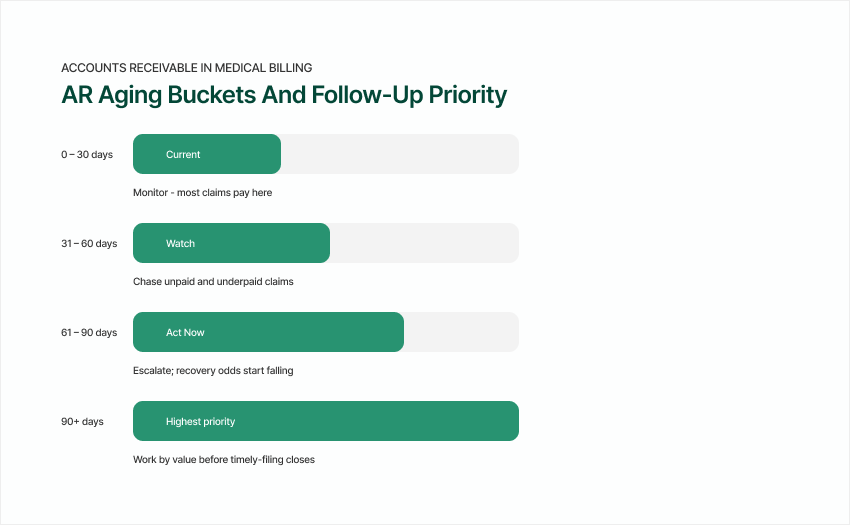
AR aging — and why it drives priority
AR aging groups outstanding balances by how long they have been unpaid: 0–30, 31–60, 61–90 and 90+ days. Aging shows which balances have waited longest, while payer filing, appeal, and follow-up rules help determine urgency. The discipline is to prioritize using value, age, status, and applicable deadlines together — not simply to work whatever surfaces first.
The AR KPIs that matter
- Days in AR — average time to collect; track it against a documented baseline for your payer and service mix
- AR aging — % of AR over 90 days
- Net collection rate — collected vs. collectible
- Denial rate and rework time — upstream drivers of AR
Days in AR is the headline, but net collection rate tells you whether you are actually capturing what you are owed, and % over 90 days tells you how much is at risk.
Best practices to reduce AR days
The levers are consistent: verify eligibility up front, submit clean claims to lift your clean claim rate, work denials fast, and prioritize follow-up by value and age. What breaks most teams is that follow-up is manual and reactive — which is exactly what automation fixes.
How automation keeps AR moving
Auto-prioritized worklists put the highest-value, most-recoverable claims in front of staff first, and automated status checks and follow-up can reduce repeatable research before staff begin complex account work. For the broader product context, review the RCM software overview. Review the claim status automation workflow for supported payer connections and exception routing. RCM Edge Accounts Receivable automation is in development; review the accounts receivable automation roadmap, use our AR automation vendor scorecard when comparing platforms, and review the focused tactics in our reduce-days-in-AR playbook.
Frequently asked questions
What is accounts receivable in medical billing?
The outstanding balances owed by payers and patients for services already delivered but not yet paid.
What are good days in AR?
Use your organization’s historical results, specialty, payer mix, contract terms, and aging distribution to set and monitor a documented target.
What is AR aging?
A breakdown of outstanding AR by how long it has been unpaid — 0–30, 31–60, 61–90, and 90+ days.
What is net collection rate?
The percentage of collectible revenue you actually collect after contractual adjustments — a truer measure than gross collections.
How do you reduce days in AR?
Fix the front end, submit clean claims, work denials fast, and prioritize follow-up by value and age; automation keeps it consistent.
Why are my AR days high?
Usually front-end errors, a low clean-claim rate, slow denial rework, or manual, reactive follow-up.
When evaluating revenue cycle analytics dashboards, confirm which aging, days-in-AR, denial, and collection measures are available for your data sources and workflow.
Related reading
- How to Reduce Days in AR: A Step-by-Step Playbook
- Denial Management in Healthcare
- Clean Claim Rate: Benchmarks and How to Improve It
For a currently available status-retrieval workflow, evaluate Claim Status Automation against your payer mix and exception-handling requirements. The broader Accounts Receivable module is in development. To discuss a scoped workflow, Book a 30-Minute Demo.