The ROI of eligibility automation: A data-driven industry report
Healthcare organizations are under more financial pressure than ever. Labor shortages are driving up administrative costs, claim denial rates continue to climb, and patients are shouldering a larger share of their bills. In this environment, every dollar of operational efficiency matters.
Yet one of the most impactful opportunities sits quietly at the very start of the revenue cycle — eligibility verification. Most providers still rely on manual workflows to confirm a patient’s insurance coverage before services are rendered. These workflows are slow, error-prone, and expensive. And they are directly responsible for a significant share of preventable claim denials.
This report examines the measurable return on investment healthcare organizations can achieve by replacing manual eligibility processes with AI-powered automation — and why industry leaders are making it a top priority.
Table of Contents
ToggleWhy eligibility verification is the most overlooked revenue cycle lever
Eligibility verification determines whether a patient is actively covered, what their deductible balance is, what copay or coinsurance applies, and whether a prior authorization is required. When this step goes wrong — or simply gets skipped — the consequences ripple through the entire revenue cycle.
Incorrect eligibility data leads to claims submitted against inactive policies, missing authorization numbers, and payer mismatches. Each of these triggers a denial. Each denial requires rework, appeals, and follow-up — all of which consume staff time and delay reimbursement. Because the error originates at the front end, by the time it surfaces, the cost of fixing it has multiplied.
“Errors made at the eligibility stage are the most expensive errors in the revenue cycle — not because they are complex, but because they are entirely preventable.”
The hidden cost of doing it manually
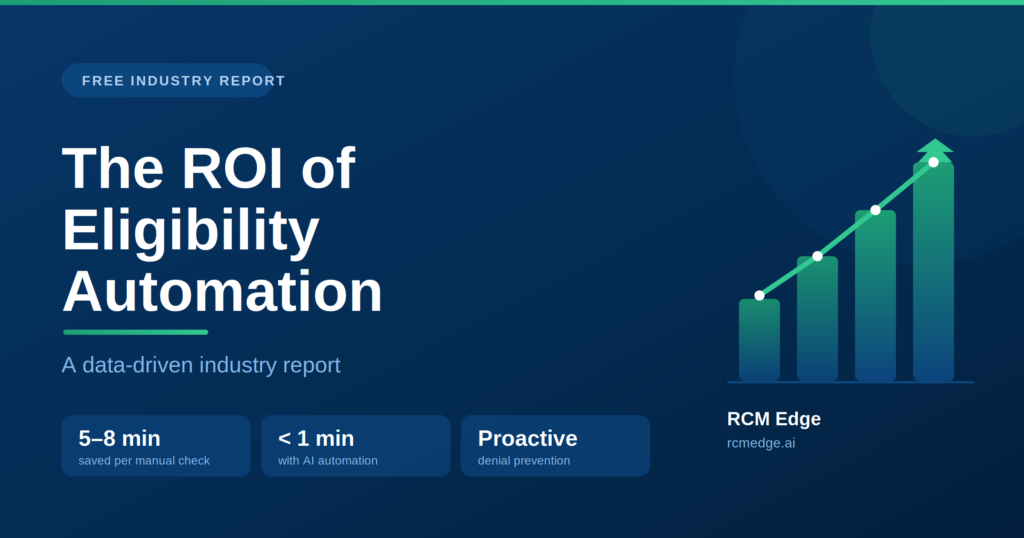
A standard manual eligibility check requires a staff member to log into a payer portal, enter patient demographics, search for coverage details, review benefits, record findings, and update the practice management system. On average, that takes 5 to 8 minutes per patient.
For an organization processing 200 verifications a day, that is between 16 and 26 staff hours consumed by a single, repetitive task — every day. Multiply that across weeks and months, and the labor cost becomes substantial. Factor in staff turnover, overtime, and the cognitive burden of monotonous portal work, and the picture gets worse.
Beyond labor, manual processes introduce human error. Incorrect member IDs, outdated coverage records, and missed policy changes all create the conditions for denials — even when staff are doing their best work.
Four ways eligibility automation drives measurable ROI
Administrative labor reduction
Automated systems verify coverage in under a minute, freeing staff from repetitive portal work and reallocating hours toward higher-value tasks.
Reduced claim denials
AI identifies inactive coverage, missing authorizations, and payer discrepancies before claims are generated — preventing denials at the source.
Faster reimbursement cycles
Clean claims are adjudicated faster. Accurate eligibility data means fewer edits, fewer rejections, and measurable reductions in Days in A/R.
Improved patient collections
Verified deductible and copay data lets staff collect patient balances upfront — reducing billing surprises and improving point-of-service collections.
What AI adds beyond basic automation
Traditional automation retrieves eligibility information. AI goes a step further by interpreting it, flagging risks, and routing exceptions intelligently.
An AI-powered system can detect patterns that frequently precede denials — inactive coverage, coordination of benefits conflicts, services that typically require prior authorization — and surface them before the appointment ever takes place. Only the complex cases that genuinely require human judgment are escalated to staff. Everything else is handled automatically.
This shift from reactive to proactive is where the real revenue protection happens. Instead of discovering an eligibility problem on an Explanation of Benefits three weeks after the visit, providers learn about it before the patient walks through the door.
See how RCM Edge can work for your organization. Our AI-powered platform automates eligibility verification end-to-end — from real-time coverage checks to exception routing.
Book a Demo ↗The case for acting now
Healthcare is moving toward increasingly automated revenue cycle management. Providers that modernize their eligibility workflows today are building a structural advantage — lower cost per claim, faster cash flow, and a staff that spends its time on work that actually requires human expertise.
Those that delay are effectively choosing to absorb preventable costs. As payer complexity grows, patient responsibility rises, and staffing remains tight, the operational gap between manual and automated organizations will only widen.
Eligibility automation is no longer an upgrade. For organizations serious about financial performance, it is becoming a baseline requirement.
Frequently asked questions
Ready to eliminate manual eligibility verification? RCM Edge helps healthcare organizations automate coverage checks, reduce denials, and accelerate reimbursement — at any scale.
Book a Demo ↗
Mithali Parekh is a healthcare technology professional specializing in revenue cycle management (RCM) automation and medical billing workflow optimization. She focuses on helping healthcare providers and billing companies improve operational efficiency by leveraging automation for processes such as claim status tracking, eligibility verification, and denial prevention.