Claim Status Automation 7 min read
AI + RPA in RCM: A Smarter Way to Improve Claim Status and Eligibility Workflows
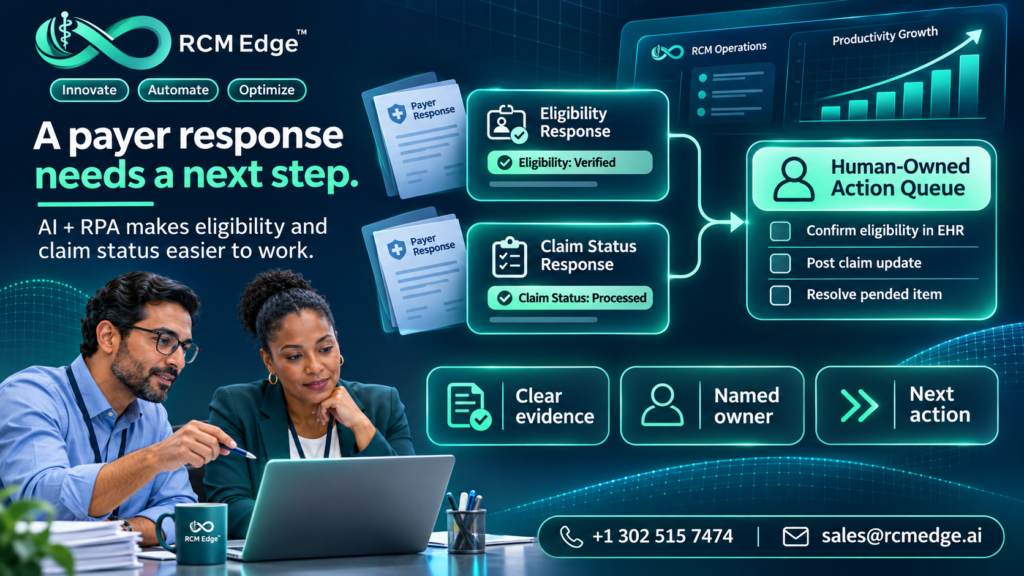
The morning schedule says a patient is covered. The billing team has a status response on another claim. Both records look like finished checks, yet someone still has to ask: “Is the information complete enough for the next person to act?”
That is a hypothetical example, but it captures an everyday problem in medical billing. A result can be technically returned without answering the operational question behind it. Staff may recheck the same portal, call the payer, or message a colleague because the handoff says only “verified” or “pending.”
AI and robotic process automation (RPA) can support faster retrieval and clearer work queues. The real improvement comes when the team agrees how to handle incomplete responses without confusing a successful lookup with a resolved account.
Two different checks, two different kinds of uncertainty
Eligibility verification happens before service or during the relevant registration workflow. Its purpose is to review coverage and available benefit information for the requested payer, plan, and service date.
Claim-status checking follows a submitted claim. It helps staff understand whether the payer has received, processed, or otherwise updated a claim, according to the response returned.
CMS identifies 270/271 as the electronic eligibility inquiry and response pair, and 276/277 as the claim-status inquiry and response pair. These are not interchangeable, and the information returned depends on the payer and transaction context. For official background, see CMS eligibility and claims-status operating rules.
The distinction matters because an eligibility response does not guarantee that a future claim will be paid. Likewise, a claim marked as processed does not, on its own, prove that payment was deposited, reconciled, or posted.
Scenario 1: Coverage is active, but the appointment still has a question
Imagine a hypothetical outpatient practice reviewing tomorrow’s schedule. A payer inquiry returns active coverage. The front desk sees a green indicator and is tempted to close the task.
But the intended service is not clearly represented in the available benefits response. The registration team also has a question about the plan information captured when the appointment was first booked.
A better response is not to label the visit cleared. It is to preserve the successful coverage check while opening an exception for the missing detail.
A useful eligibility exception record should answer:
- Which payer and plan were checked, and for what intended date of service?
- Which benefit or service-specific field is missing, unclear, or inconsistent?
- What did the payer actually return, and when?
- Which person will clarify the issue and how will that answer be documented?
- What is the next review time, considering the appointment schedule?
For Medicare eligibility, CMS describes its HETS 270/271 service as a real-time inquiry system. It does not accept batch transactions through that specific application. This does not mean every other payer or software integration has the same technical restrictions. Confirm the actual access route before designing the workflow. See CMS HETS guidance.
Scenario 2: Claim status was retrieved, but no one owns the next step
Consider a second hypothetical case. A billing specialist requests status on a submitted claim. A 277 response arrives, but its description does not establish what should happen next. A teammate later performs the same lookup, hoping for more detail.
This repeated checking feels productive because someone is working the account. It can also consume capacity without changing the underlying position.
The first question should be: What specific missing information would make the next action clear? The answer might be confirmation that the payer received the right claim, clarification of an error response, or a properly documented follow-up after the payer’s next update window.
CMS lists provider portals, IVR systems, and electronic 276/277 requests among the available Medicare claim-status routes. The channel is less important than preserving which response was obtained and what it supports. See CMS claim-status request and response.
Use a five-field exception handoff
A practical way to connect automation with human review is to require five fields whenever a result cannot be used immediately.
1. What was requested?
Record whether the transaction was eligibility or claim status, and keep the relevant payer, date, and secure internal reference. Avoid pasting member IDs or other protected data into a general team chat.
2. What actually came back?
Summarize the response accurately and retain access to the underlying evidence. “No response” is different from “inactive coverage,” just as “processing” is different from “paid.”
3. What remains unanswered?
Write the obstacle as a question a colleague can investigate. “Verify service-specific benefit” is more helpful than “eligibility issue.” “Confirm payer receipt” is clearer than “claim pending.”
4. Who owns it?
Assign an individual or authorized team. Without ownership, a flagged exception can become another shared spreadsheet row that nobody moves forward.
5. When will it be reviewed again?
Set a review time appropriate to the appointment, payer guidance, and operational policy. Do not invent a universal 24-hour or 48-hour rule that applies to every payer.
Example internal handoff, using no real patient data: “Eligibility check completed for intended service date. Active response received. Service-specific benefit detail not returned. Owner: Patient Access Lead. Next action: confirm detail through approved payer channel before registration decision. Recheck at tomorrow’s scheduling huddle.”
What AI + RPA should do before it reaches your staff
RPA can handle configured, repeatable retrieval steps through supported connections. Software can then present results and identify missing or conflicting responses for review. AI-assisted summaries may help staff read some outputs, but only where that feature is actually available and has been evaluated for accuracy.
The team should not expect automation to make every coverage determination, resolve every claim, or replace payer-specific judgment. The safe goal is a usable record, a visible exception, and a person able to act.
CAQH CORE maintains operating rules for eligibility and claim status that address electronic exchange infrastructure and information consistency. That context helps explain why standardized transactions matter, but it does not guarantee that every response contains all details a particular provider needs. See the CAQH CORE operating rules.
Run a 10-account handoff audit
Before expanding an automation workflow, take ten recent records that required a second manual check. Split them between eligibility and claim-status cases and review them with staff who actually handle the queue.
For each record, ask:
- Was the source response saved or traceable?
- Could the next person tell what was confirmed and what was missing?
- Did the record have one accountable owner and a next review time?
- Did the repeat check produce meaningful new information?
- What would have prevented the repeated work?
Use the answers to define exception categories and training needs. Re-run the same audit after a pilot using comparable records. The point is not to prove every check was perfect; it is to see whether the team can act with less unnecessary repetition.
What RCM Edge AI can support now
RCM Edge’s live workflows are Eligibility Verification and Claim Status Automation. Its published site identifies 566 supported eligibility payer connections and 468 supported claim-status payer connections. Coverage is workflow-specific and must be validated against actual payer IDs, plans, and requirements.
For eligibility, the platform can organize coverage and benefit responses and flag missing or unclear results for staff attention. For claim status, it can support repeated status retrieval and organize unresolved results into follow-up work. Review the eligibility product page and the claim-status product page for the available scope.
Prior Authorization, Denial Management, and Accounts Receivable automation are under development, not live modules. A product demo should demonstrate a supported workflow using a representative, appropriately protected sample, rather than imply all RCM tasks are autonomous.
One result worth asking for
When you evaluate an AI + RPA workflow, do not stop at “How quickly can it check a thousand records?” Ask: “When the answer is incomplete, will my staff know exactly what to do next?”
That question connects technology to daily billing reality. Better retrieval is useful. A handoff that avoids another search and helps a colleague resolve the actual problem is even more valuable.
If your team wants to evaluate the fit for its payer mix, contact us:
sales@rcmedge.ai | +1 302 515 7474