Revenue Cycle Management 8 min read
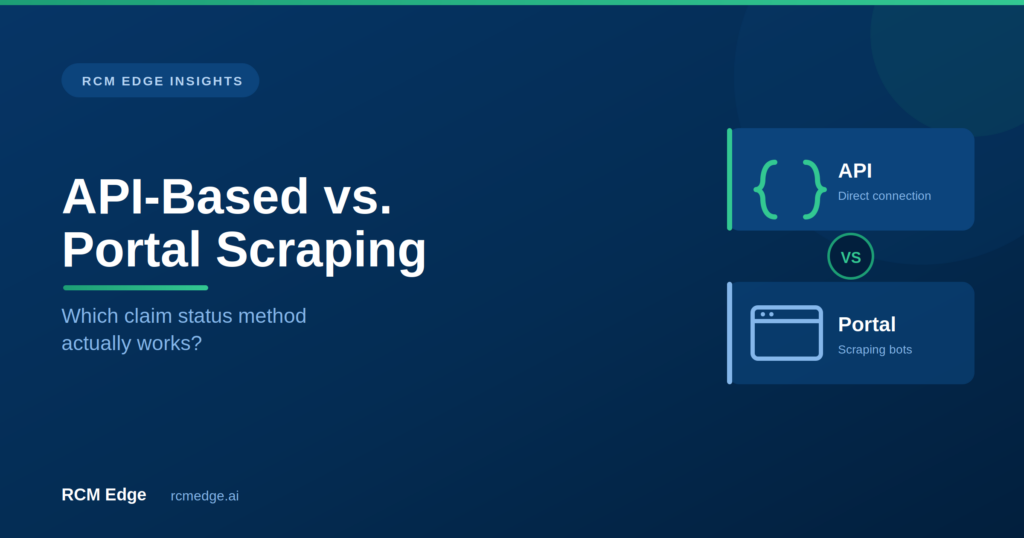
API-Based vs. Portal Scraping: Which Claim Status Method Actually Works?
API-Based vs. Portal Scraping: Which Claim Status Method Actually Works?
For healthcare providers, medical billing companies, and revenue cycle management teams, claim status follow-up can require repeated payer research, documentation, and exception handling. The operational burden depends on claim volume, payer mix, inquiry method, and how consistently the team records and acts on returned statuses.
As healthcare organizations look to automate these workflows, two primary approaches have emerged: API-based claim status retrieval and portal scraping automation. Both methods can reduce manual claim-status research, but the tradeoffs depend on payer coverage, supported transactions, maintenance, authentication, exception handling, and total operating cost.
In this article, we compare API-based claim status retrieval and portal automation, examine their strengths and limitations, and provide a payer-by-payer evaluation framework. If you are deciding whether to automate at all, first review our manual vs automated claim status checks comparison.
Why Claim Status Follow-Up Matters in Revenue Cycle Management
Claim status follow-up is a critical component of the revenue cycle. After claims are submitted, providers must monitor them to determine:
- Whether the claim has been received
- Current processing status
- Payment timelines
- Rejection reasons
- Denial information
- Additional documentation requests
- Appeals requirements
When status results are not collected and routed consistently, teams may discover exceptions later than planned. Automation can reduce repetitive retrieval work, but the result still depends on payer coverage, response quality, exception ownership, and timely staff action.
Traditional Claim Status Follow-Up Challenges
Many healthcare organizations still rely on manual workflows: logging into payer portals, searching for claim details, reviewing claim status, recording updates, assigning follow-up actions, and repeating the process across multiple payers. The 2024 CAQH Index reported an average of 25 minutes for a manual medical claim-status inquiry by phone in its 2023 data. That industry estimate is not a savings guarantee; measure your own payer mix and staff touch time.
Common Problems with Manual Follow-Up
Administrative Burden
Staff spend significant time performing repetitive tasks.
Human Error
Manual re-entry creates an additional opportunity for inconsistent or incomplete documentation.
Delayed Follow-Up
Claims may sit unresolved because teams cannot review every account promptly.
Limited Scalability
As claim volume grows, inquiry capacity remains tied to available staff time unless the workflow changes.
What Is Portal Scraping?
Portal scraping is a method that uses software bots to log into payer portals and retrieve claim status information automatically. The technology mimics human actions such as entering login credentials, navigating websites, searching claims, extracting information, and recording claim updates. Portal automation can extend access where a suitable direct electronic transaction or endpoint is unavailable, subject to payer terms, authentication, and technical controls.
Advantages of Portal Scraping
Broad Payer Coverage
Portal availability and permitted automation vary by payer. Where an approved portal workflow exists, automation may extend coverage beyond available direct integrations, including some legacy or payer-specific workflows.
Lower Initial Integration Requirements
Portal automation may avoid a custom API integration, but it still requires approved credentials, authentication handling, workflow configuration, security review, testing, and ongoing maintenance.
Limitations of Portal Scraping
Frequent Maintenance Requirements
A portal layout, authentication method, session rule, or anti-automation control can change. Those changes may interrupt a configured workflow until it is reviewed and updated.
Reliability Concerns
Portal scraping depends entirely on website availability. Potential issues include portal downtime, session timeouts, credential lockouts, and connectivity disruptions, all of which can impact automation performance.
Security Risks
Managing credentials across multiple payer portals can create security challenges. Organizations must securely store usernames, passwords, and authentication methods. As cybersecurity requirements increase, credential management becomes more complex.
What Is API-Based Claim Status Automation?
API stands for Application Programming Interface. APIs allow systems to exchange information directly without requiring website interactions. Instead of logging into payer portals, API-based systems retrieve claim information through secure system-to-system connections. Structured system-to-system connections can reduce dependency on webpage layouts, but stability and scale still depend on the payer endpoint, transaction support, rate limits, implementation, and exception handling.
Advantages of API-Based Claim Status Retrieval
Real-Time Data Access
APIs can provide structured, system-to-system status responses when payer endpoints and transaction support are available.
Higher Reliability
Unlike portal automation, APIs do not depend on webpage layouts. That can reduce layout-related maintenance, although availability, response behavior, and uptime still depend on each payer connection and implementation.
Better Security
API and portal approaches both require a documented security review. Authentication, access control, audit controls, and transmission security should be evaluated for any workflow handling electronic protected health information.
Standardized Data
APIs can return structured responses that support downstream rules, alerts, reporting, and billing-system integration. Staff still need to review ambiguous results and work exceptions.
API-Based vs. Portal Scraping Comparison
| Feature | API-Based Method | Portal Scraping Method |
|---|---|---|
| Coverage | Depends on payer transaction or endpoint support | Depends on payer portal availability and permitted automation |
| Response format | Usually structured; confirm fields and mappings | Extracted from portal pages; confirm normalization rules |
| Primary dependency | Endpoint, transaction support, authentication, and rate limits | Page flow, authentication, session rules, and portal changes |
| Maintenance | Monitor endpoint and transaction changes | Monitor portal, layout, and authentication changes |
| Security review | Review access, authentication, transmission, logging, and data handling | Review credentials, access, authentication, logging, and data handling |
| Response timing | Varies by payer, transaction, and implementation | Varies by payer portal and workflow |
| Best evaluation method | Test representative payers and real response scenarios | Test representative payers, authentication, and change recovery |
Which Method Scales Better?
As claim volume grows, evaluate whether each method can sustain the required inquiry volume, response time, retry behavior, exception queue, and maintenance workload.
Portal Scraping Challenges
Portal workflows may require additional monitoring and maintenance as payer coverage, authentication methods, and transaction volume expand.
API Advantages
A structured connection may reduce webpage-related maintenance, but do not assume lower total overhead. Compare payer coverage, rate limits, response behavior, implementation effort, monitoring, and support requirements.
The Role of AI in Modern Claim Status Automation
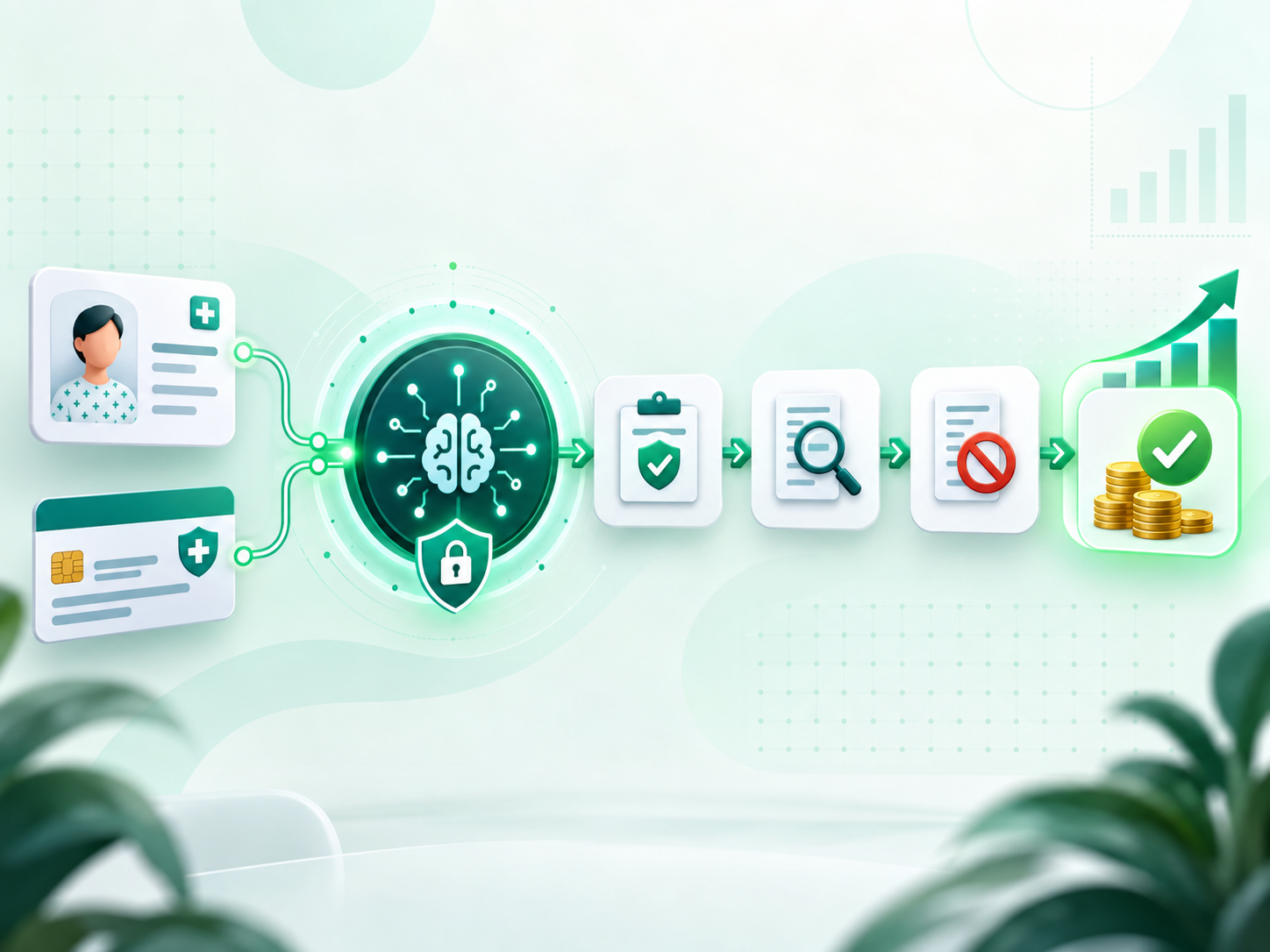
The decision is broader than API versus portal automation. After retrieving a status, the system must normalize the result, apply approved rules, route exceptions, and preserve human review.
Automated Claim Prioritization
Rules or analytical models can prioritize claims using approved fields such as age, balance, returned status, and follow-up due date. The logic, thresholds, and overrides should be validated during a pilot.
Intelligent Status Interpretation
Different payers often use different terminology. Normalization logic can map payer-specific status wording into defined operational categories such as pending, documentation requested, rejected, or paid. Test mappings against representative responses and retain an exception path.
Workflow Automation
Workflow rules can assign tasks, route exceptions, and notify billing teams. Measure the effect on staff touch time and action completion instead of assuming a fixed reduction.
Why Healthcare Organizations Are Moving Toward Hybrid Models
No single connection method covers every payer and use case. A hybrid design may combine supported electronic transactions, payer endpoints, and approved portal workflows. Evaluate each connection for coverage, permitted use, authentication, reliability, maintenance, and response quality.
How RCM Edge Automates Claim Status Follow-Up
RCM Edge Claim Status supports repeatable inquiry and exception workflows across 468 payer connections. Confirm your required payer mix during evaluation. The workflow is designed to:
Official Standards and Security Guidance
CMS explains the adopted ASC X12N 276/277 claim-status inquiry and response standard. For security evaluation, review the HHS HIPAA Security Rule summary, including access control, audit controls, authentication, and transmission security.
Internal Resources
Learn more about healthcare automation:
Future Outlook: The Next Generation of Claim Status Management
Healthcare organizations can evaluate API, EDI, and portal-supported workflows payer by payer, then measure maintenance effort, response coverage, exception rates, and staff touch time during a controlled pilot.
Conclusion
API-based integrations and portal automation can both support claim-status workflows. Portal access may extend coverage where a direct transaction or endpoint is unavailable, while structured connections can simplify response processing. The right mix depends on payer coverage, security controls, maintenance, and exception handling.
Select the approach using documented payer requirements and a measurable pilot. Automation should surface returned status information and route exceptions, while experienced staff remain responsible for payer escalation and complex account decisions.
Frequently Asked Questions
Evaluating claim status automation? See how RCM Edge handles supported connections, returned statuses, and exception workflows using your representative payer mix.