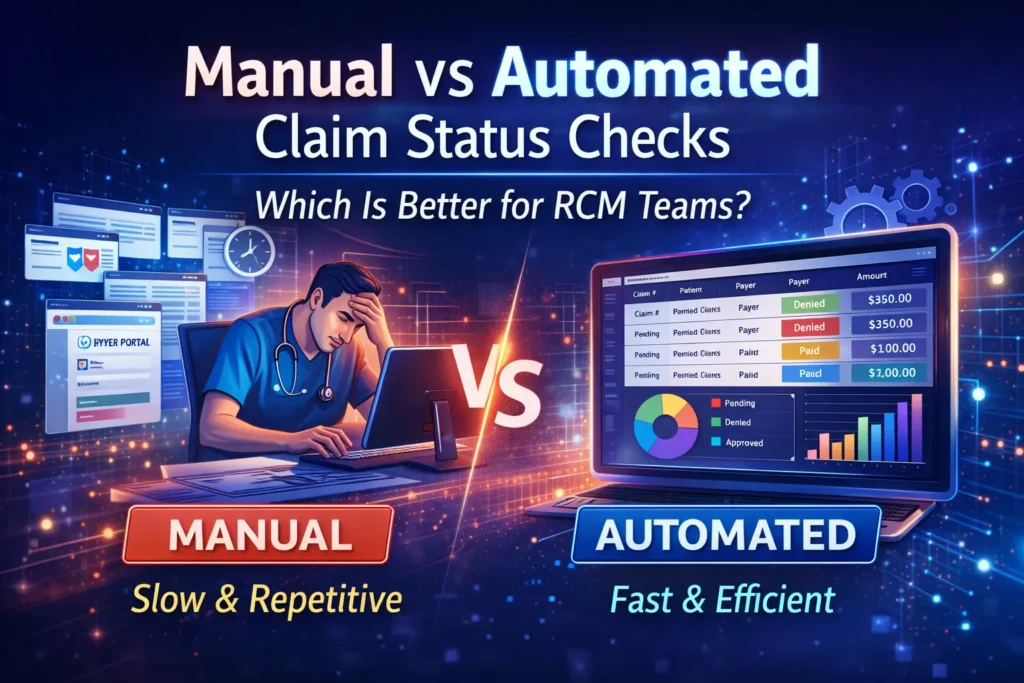
Manual vs Automated Claim Status Checks: Which Is Better for RCM Teams?
Healthcare revenue cycle teams handle thousands of insurance claims every week. After claims are submitted to insurance payers, billing teams must continuously monitor their status to ensure payments are processed correctly and on time. This process is known as claim status checking, and it plays a critical role in reducing reimbursement delays and improving cash flow.
However, many revenue cycle management (RCM) teams still rely on manual claim status checks, which involve logging into payer portals and checking each claim individually. While this method has been used for years, it is becoming increasingly inefficient as claim volumes grow and payer requirements become more complex.
Modern healthcare organizations are now adopting automated claim status checking solutions to streamline billing workflows and improve efficiency. Automation tools allow billing teams to track claim progress in real time without manually accessing multiple payer systems.
In this article, we compare manual vs automated claim status checks and explore which approach is better for modern RCM teams.
What Is Claim Status Checking?
Claim status checking is the process of verifying the progress of a submitted medical claim within a payer’s system. Once a claim is submitted, it goes through several stages before payment is issued.
Common claim statuses include:
- Claim received by payer
- Claim under review
- Claim pending additional information
- Claim approved
- Claim denied
- Payment issued
Monitoring these statuses allows billing teams to identify issues early and take corrective action before delays affect revenue collection.
Effective claim status monitoring helps healthcare organizations:
- Prevent claim aging
- Reduce accounts receivable (AR) days
- Improve reimbursement timelines
- Identify claim processing issues quickly
Without regular monitoring, claims may remain unresolved for long periods, which negatively impacts revenue cycle performance.
What Are Manual Claim Status Checks?
Manual claim status checking is the traditional method used by billing teams to track claims.
In this approach, billing staff must:
- Log into individual payer portals
- Search for the specific claim
- Review the claim status update
- Record the information in their billing system
- Identify any required follow-up action
This process must be repeated for every claim across multiple insurance payers.
While manual tracking may work for small practices with low claim volumes, it becomes extremely inefficient for organizations managing large numbers of claims.
Challenges of Manual Claim Status Checks
Time-Consuming Process
Billing specialists may spend several hours each day checking claim statuses across multiple payer portals. Each payer system has different login procedures and search formats, making the process slow and repetitive.
When claim volumes increase, manual tracking quickly becomes unsustainable.
Limited Claim Visibility
Manual claim monitoring provides only periodic updates rather than continuous visibility.
If billing teams check claim status once a week, issues may go unnoticed for several days. During this time, claims remain unresolved and continue to age.
Delayed Claim Follow-Ups
Without automated alerts, billing teams may not realize that a claim requires attention until much later.
This delay can lead to:
- Missed filing deadlines
- Increased claim denials
- Longer reimbursement cycles
As a result, AR days increase and revenue collection slows down.
Increased Administrative Burden
Manual claim tracking requires significant staff time and effort. Billing teams often spend a large portion of their day navigating payer systems rather than resolving claim issues.
This administrative burden reduces productivity and increases operational costs.
What Is Automated Claim Status Checking?
Automated claim status checking uses technology to monitor claim progress across multiple payers automatically.
Instead of manually searching for each claim, automation tools retrieve claim status updates in bulk and present them in a centralized dashboard.
Automation platforms can:
- Query payer systems automatically
- Retrieve claim status updates in bulk
- Identify claims requiring follow-up
- Provide real-time claim monitoring
- Generate alerts for claim issues
Automation significantly reduces the time required to track claims and improves billing efficiency.
How Automated Claim Status Checking Improves RCM Workflows
Real-Time Claim Monitoring
Automated systems continuously track claim progress across payer systems.
This means billing teams always have access to the most up-to-date claim information without logging into multiple portals.
Real-time visibility allows revenue cycle teams to respond quickly when issues arise.
Faster Claim Follow-Ups
Automation tools immediately identify claims that require attention, such as those that are:
- Rejected by the payer
- Pending documentation
- Delayed in processing
With automated alerts, billing teams can take action immediately rather than waiting days or weeks to discover the problem.
Improved Staff Productivity
Automation eliminates repetitive tasks like portal logins and manual claim searches.
Billing teams can review the status of hundreds or thousands of claims within minutes using a centralized dashboard.
This allows staff to focus on higher-value activities such as:
- Denial management
- Appeals processing
- Payment reconciliation
- Revenue optimization
Bulk Claim Status Tracking
One of the biggest advantages of automation is the ability to check claim status in bulk.
Instead of reviewing claims individually, automation tools can retrieve updates for large volumes of claims simultaneously.
This dramatically reduces the time required for claim monitoring.
Manual vs Automated Claim Status Checks
| Feature | Manual Claim Status Checks | Automated Claim Status Checks |
| Speed | Slow and time-consuming | Fast and automated |
| Claim Volume Handling | Limited scalability | Handles large claim volumes |
| Claim Monitoring | Periodic manual checks | Continuous monitoring |
| Staff Productivity | High administrative workload | Reduced manual tasks |
| Claim Visibility | Limited visibility | Real-time dashboards |
| Follow-Up Efficiency | Delayed follow-ups | Immediate alerts |
This comparison clearly shows that automated systems offer significant advantages for modern revenue cycle teams.
The Role of Automation Platforms Like RCM Edge
Advanced automation platforms are transforming how healthcare organizations manage claim tracking.
Solutions like RCM Edge allow revenue cycle teams to automate claim status monitoring and gain real-time insights into their billing operations.
With RCM Edge, billing teams can:
- Check bulk claim status across multiple payers
- Monitor claim progress through a centralized dashboard
- Identify claims requiring follow-up instantly
- Reduce manual portal logins
- Improve overall revenue cycle efficiency
By eliminating repetitive claim tracking tasks, RCM Edge enables billing teams to focus on resolving claim issues and accelerating reimbursements.
Why RCM Teams Are Moving Toward Automation
Healthcare organizations today face increasing pressure to improve operational efficiency and reduce administrative costs.
At the same time, claim volumes continue to rise due to:
- Expanding patient populations
- Increasing insurance coverage
- Growing regulatory complexity
Manual claim monitoring simply cannot keep up with these demands.
Automation technologies allow revenue cycle teams to scale their operations while maintaining accuracy and efficiency.
By adopting automated claim status solutions, healthcare organizations can modernize their billing workflows and improve financial performance.
Conclusion
Claim status monitoring is a critical component of effective revenue cycle management. While manual claim status checks have traditionally been used by billing teams, they are no longer sufficient for modern healthcare organizations managing large claim volumes.
Automated claim status checking offers a faster, more efficient alternative that provides real-time claim visibility and reduces administrative workload.
By adopting automation platforms like RCM Edge, healthcare providers and billing companies can streamline their claim monitoring processes, improve staff productivity, and accelerate reimbursements.
As the healthcare industry continues to embrace digital transformation, automated claim tracking will play an increasingly important role in building more efficient and resilient revenue cycle operations.
