How Bulk Claim Status Automation Reduces AR Days in Medical Billing
In healthcare revenue cycle management (RCM), one of the most critical financial performance indicators is Days in Accounts Receivable (AR Days). This metric measures how long it takes for healthcare providers to receive payment after a claim is submitted to an insurance payer.
When AR days increase, it directly affects cash flow, operational efficiency, and financial stability for healthcare organizations.
One of the biggest contributors to rising AR days is manual claim status tracking. Billing teams often spend hours logging into payer portals, checking claim progress, and documenting updates. This slow and repetitive process delays follow-ups and prevents billing teams from identifying claim issues early.
Bulk claim status automation solves this problem by allowing billing teams to check the status of hundreds or thousands of claims simultaneously across multiple payers. With the help of modern automation platforms like RCM Edge, healthcare organizations can dramatically reduce AR days, improve claim follow-ups, and accelerate reimbursements.
This article explains how bulk claim status automation works and why it plays a critical role in reducing AR days in medical billing.
Understanding AR Days in Medical Billing
Days in Accounts Receivable represents the average number of days it takes to collect payments from insurance companies after claims are submitted.
The formula for AR days is typically calculated as:
AR Days = (Total Accounts Receivable / Average Daily Charges)
Lower AR days indicate an efficient billing process and faster reimbursements. Higher AR days suggest that claims are delayed, stuck in processing, or not being followed up effectively.
Industry benchmarks generally recommend keeping AR days below 40–45 days for a healthy revenue cycle. However, many healthcare organizations struggle to maintain this benchmark due to inefficient workflows and manual billing processes.
When claims remain unmonitored, they may experience:
- Processing delays from payers
- Missing documentation requests
- Coding errors or claim edits
- Claim rejections or denials
Without timely intervention, these issues can leave claims unresolved for weeks or months, increasing AR days and slowing revenue collection.
The Challenge of Manual Claim Status Checking
Despite advances in healthcare technology, many billing teams still rely on manual claim status checks.
This process typically involves:
- Logging into multiple payer portals
- Searching for individual claim details
- Reviewing claim status updates
- Recording the information in billing systems
- Identifying claims that require follow-up
While manageable for small practices, this process becomes extremely inefficient for organizations handling high claim volumes.
Some of the most common challenges include:
Time-Consuming Workflows
Billing specialists may spend several hours each day navigating different payer websites just to check claim progress.
Lack of Real-Time Visibility
Manual claim tracking provides only periodic updates rather than continuous monitoring of claims.
Delayed Issue Detection
If claim status is checked only once every few days or weeks, problems may remain unnoticed for extended periods.
Administrative Burden
Repetitive tasks reduce productivity and increase operational costs for billing organizations.
As a result, many claims remain in limbo without timely follow-ups, causing AR days to increase.
What Is Bulk Claim Status Automation?
Bulk claim status automation is a technology-driven approach that allows billing teams to retrieve claim status updates for multiple claims simultaneously across different payers.
Instead of manually checking each claim individually, automation platforms automatically query payer systems and retrieve claim status information in bulk.
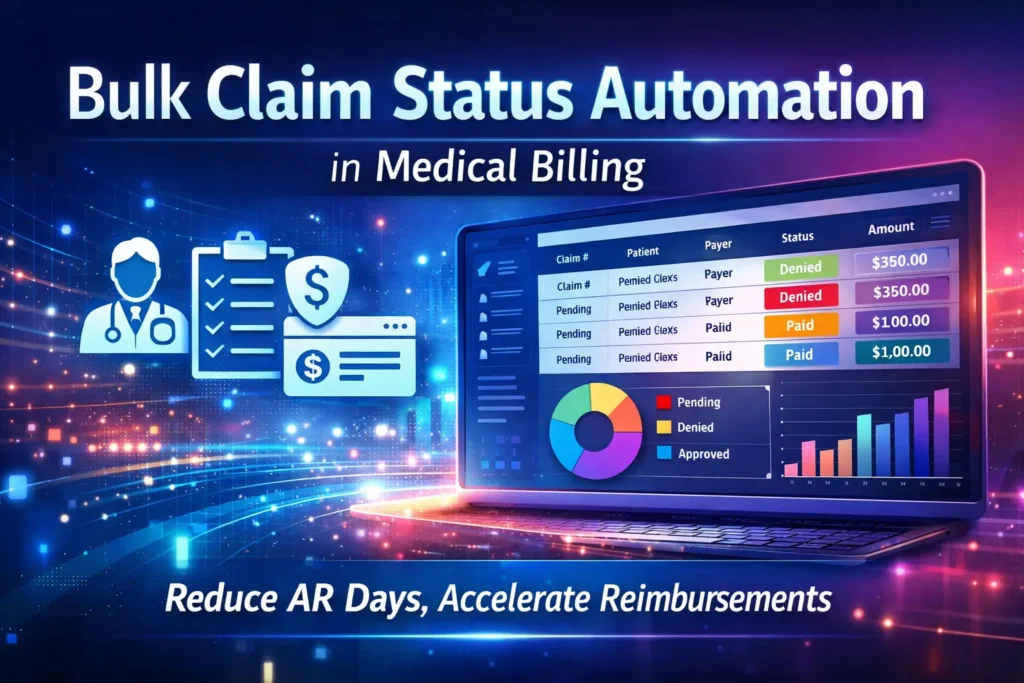
These platforms provide a centralized dashboard where billing teams can monitor claim progress, identify issues, and take immediate action.
Solutions like RCM Edge enable revenue cycle teams to automate claim tracking and gain real-time insights into the status of their claims without logging into multiple payer portals.
This automation significantly reduces the time required to monitor claims and allows billing teams to focus on resolving issues faster.
How Bulk Claim Status Automation Reduces AR Days
1. Faster Claim Follow-Ups
One of the primary reasons AR days increase is delayed follow-ups on submitted claims.
Without automation, billing teams may take several days or weeks to review claim status updates. During this time, claims may remain unresolved in payer systems.
Bulk claim status automation allows billing teams to instantly identify claims that require attention.
For example, automated systems can quickly highlight claims that are:
- Pending payer review
- Awaiting additional documentation
- Rejected due to coding errors
- Delayed in payer processing
By identifying these issues immediately, billing teams can take action faster and prevent claims from aging unnecessarily.
2. Early Detection of Claim Issues
Many claims remain unpaid simply because billing teams are unaware that a problem exists.
Bulk claim status automation provides continuous monitoring of claims and flags potential issues early in the revenue cycle.
These issues may include:
- Missing patient information
- Incorrect procedure codes
- Eligibility verification problems
- Payer processing delays
Early detection enables billing teams to correct errors quickly before they escalate into claim denials or extended delays.
3. Improved Billing Staff Productivity
Manual claim status checks consume a significant portion of a billing specialist’s daily workload.
Automation removes the need to log into multiple payer portals and search for individual claims.
With automation tools like RCM Edge, billing teams can review claim statuses for thousands of claims within minutes through a single dashboard.
This allows billing staff to focus on higher-value tasks such as:
- Denial management
- Appeals processing
- Revenue optimization
- Patient billing support
By improving staff productivity, claims are processed and resolved more efficiently.
4. Real-Time Claim Visibility
Without automation, claim monitoring often happens periodically rather than continuously.
Bulk claim status automation provides real-time visibility into claim progress, allowing billing managers to track claim performance across multiple payers.
With a centralized dashboard, revenue cycle teams can easily identify:
- Claims awaiting payment
- Claims that require follow-up
- Claims pending additional information
- Claims delayed in payer systems
This level of visibility helps billing teams manage the revenue cycle proactively and prevent claims from aging unnecessarily.
5. Better Claim Prioritization
Not all claims require immediate action. However, some claims demand urgent attention, especially those that involve:
- High reimbursement amounts
- Filing deadlines approaching
- Extended processing times
Bulk claim status automation helps billing teams prioritize claims based on urgency and financial impact.
This ensures that high-risk claims receive immediate attention, improving recovery rates and reducing AR days.
6. Reduced Claim Backlogs
Manual claim monitoring often results in backlogs where large numbers of claims remain unreviewed.
Automation allows billing teams to process and review claim statuses in bulk, eliminating the need for time-consuming manual checks.
By clearing claim backlogs faster, healthcare organizations can ensure that claims move through the revenue cycle more efficiently.
The Role of Automation Platforms Like RCM Edge
Modern RCM automation platforms are designed to simplify complex billing workflows.
Platforms such as RCM Edge help healthcare organizations automate claim tracking and gain better visibility into payer responses.
With RCM Edge, billing teams can:
- Check bulk claim status across multiple payers
- Monitor claim progress through a centralized dashboard
- Identify claims that require immediate follow-up
- Reduce manual portal logins
- Improve overall revenue cycle efficiency
By automating claim status checks, RCM Edge helps healthcare organizations streamline their billing operations and accelerate reimbursements.
Why Automation Is the Future of Revenue Cycle Management
The healthcare industry continues to experience rapid growth in claim volumes and payer complexity.
At the same time, healthcare providers face increasing pressure to reduce administrative costs and improve financial performance.
Automation technologies are becoming essential for modern revenue cycle operations.
By adopting automation tools for claim monitoring and follow-ups, healthcare organizations can:
- Reduce operational inefficiencies
- Improve billing accuracy
- Accelerate reimbursement cycles
- Enhance staff productivity
- Strengthen financial stability
Bulk claim status automation represents a key step toward building a smarter and more efficient revenue cycle management system.
Conclusion
Managing AR days effectively is essential for maintaining financial stability in healthcare organizations. However, manual claim tracking processes often prevent billing teams from identifying issues quickly and following up on claims efficiently.
Bulk claim status automation transforms the way healthcare organizations manage claims by providing real-time visibility, faster follow-ups, and improved workflow efficiency.
Platforms like RCM Edge empower revenue cycle teams to automate claim status tracking, reduce administrative workload, and accelerate reimbursements.
By implementing bulk claim status automation, healthcare providers and billing companies can significantly reduce AR days, improve cash flow, and create a more efficient billing operation.